
Non-halal conventional route: from animal receipt to chilled product
Start with the competent veterinary and welfare team’s operating requirements for the proposed sheep/goat facility. The conventional route needs a defined handling and slaughter method, appropriate process checks and a hygienic path through dressing and product release.
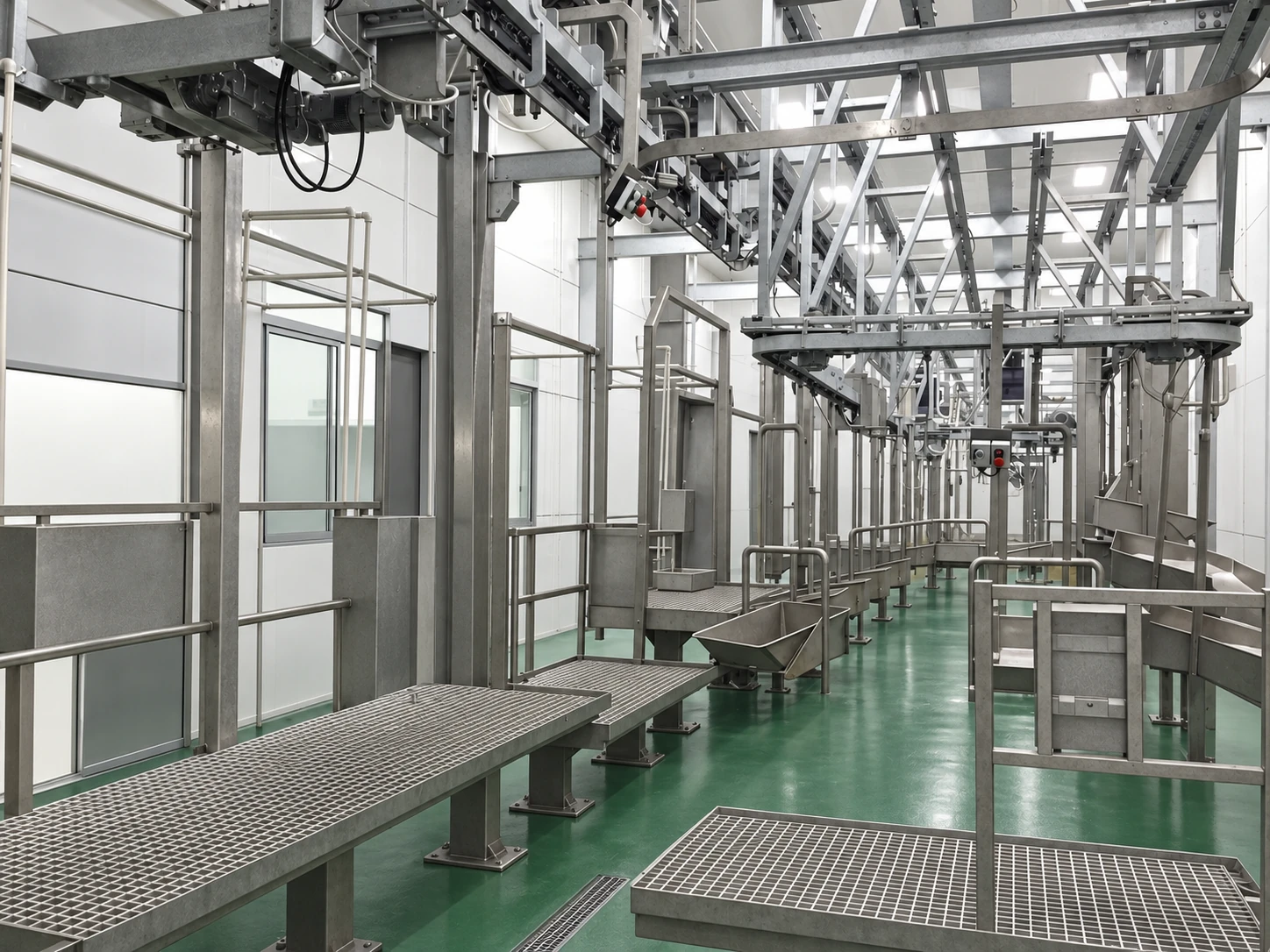
01 / Receiving and veterinary controls
Identify the sheep and goat supply, arrival condition and lairage route. Set an ante-mortem examination and held-animal arrangement with the competent veterinary team. A non-halal project still requires animal welfare, food-safety and local operating review.
02 / Restraint and stunning decision
Have the authority-approved operating plan define animal handling, restraint and the slaughter method. Where stunning is required or selected, the veterinary/welfare team must review the technique, effectiveness checks, trained personnel and backup arrangement. No universal species setting or legal exemption is specified by this equipment guide.
03 / Slaughter and the lifting connection
Locate the work position, lifting path and beginning of the bleeding rail according to the agreed conventional procedure. Keep animal handling and operator access coordinated with sanitation and collection. The source rail photograph does not prove a particular stunning device is included.
04 / Bleeding and verification before dressing
Set the process checks that prevent an animal from reaching dressing before the required slaughter and death-confirmation conditions are satisfied. Document any monitoring, ineffective-stun response and held-material decisions in the operating procedure reviewed by the competent team.
05 / Horizontal pre-skinning and preparation
Provide the manual preparation tasks needed by the chosen dehider. Review head handling, brisket-skin opening and flank/shoulder preparation with the hanging geometry. The incoming sheep and goat range affects working access and task allocation.
06 / Mechanical hide removal
Locate the roller or hydraulic dehider after the agreed preparation sequence. Route skins away from exposed dressed product and provide cleaning and maintenance access. Specify the intended sheep/goat suitability rather than assuming that a sheep-equipment photograph proves every goat configuration.
07 / Rehanging and evisceration interfaces
Connect the hind-leg hanging arrangement to the clean dressing work positions. Mark the offal receiving path and its relation to carcass identity. Equipment locations must support the process hygiene plan and the local veterinary inspection procedure.
08 / Inspection, hold and trimming
Reserve the veterinary work positions, associated material presentation and hold/reject routes after evisceration. Position trimming access around the inspection decision. Product release is an operating control that needs a defined responsible party, not merely an additional conveyor length.
09 / Final handling and chilled-rail transfer
Review the final product handling or washing arrangement against sanitation, drainage and cold-room entry. Match hooks, rail elevation and doorway clearances with the cold-chain design. Refrigeration, storage and downstream cutting remain explicit scope items.
10 / Operating review and onward product route
Keep welfare, sanitation, inspection and traceability records for the approved conventional operation. If the owner later requests halal production, start a separate certification and layout review; a change of label or work shift is not evidence that shared premises or tools meet the new requirements.
Match the approved route to the equipment
Hoisting and bleeding interfaces
Locate the lifting handoff and rail only after the method and release checks are agreed.
Dehiding arrangements
Compare roller and hydraulic options with the proposed sheep/goat range and preparation.
Inspection work positions
Reserve the carcass, offal and held-material routes with the local veterinary team.
Chilling transfer
Coordinate the final rail with the separately defined cold-room scope.
Before the equipment brief is signed
- Name the local veterinary authority and the party responsible for site/operating approval.
- State the conventional slaughter method and who approves the associated welfare controls.
- Document the animal mix, the normal and any seasonal work pattern, and the product route.
- Mark utilities, hygiene routes, maintenance access and the inspection/held-product positions on the drawing.
- Record unresolved decisions and exclude unapproved assumptions from the purchasing schedule.
Plan a new facility for this route · Country regulations and sources · Building checklist
Confirm this route for the proposed country
The route above is a project sequence to review, not proof that every country accepts the same method or shared facility arrangement.
Malaysia
Confirm the admissible conventional route with State DVS and local authorities. A non-halal website route does not bypass ruminant operating conditions.
The DVS operating-licence packet for ruminants includes halal slaughterer authorization. Ask State DVS whether the proposed non-halal sheep/goat operation is admissible at this site before selecting equipment. Personnel authorization and premises halal certification are different decisions. DVS private slaughterhouse build application and checklist (Department of Veterinary Services Malaysia; PDF page 3, checklist items 1–11).
Indonesia
Ask how the proposed product and slaughter method are licensed and labelled under JPH. Do not treat a conventional route as a blanket exemption.
The statutory halal/non-halal separation covers locations, work areas and equipment. A shared line changed between shifts is not presumed compliant. Agree the actual small-ruminant facility, product classification and physical boundaries with the applicable veterinary and JPH reviewers. Government Regulation No. 42 of 2024 on Halal Product Assurance (Government of Indonesia / BPJPH; Articles 6–9, 196–198; PDF pages 4–6 and 73–74).
Kazakhstan
Prepare the proposed restraint, slaughter and product route for veterinary, food-safety and environmental review without making a halal conformity claim.
Uzbekistan
Plan the conventional operation through the same applicable veterinary, building and environmental reviews; do not add a halal label without supporting conformity.
Boundary for this route
- The proposed country must accept the operating method and product route before procurement.
- Malaysia's ruminant operating packet has slaughterer halal-authorization conditions; the conventional option is not automatically available there.
- Indonesia JPH classification, labelling and separation require explicit review; a conventional label is not a blanket exemption.
- Veterinary inspection, welfare and controlled held/rejected-material routes remain part of the plan.